
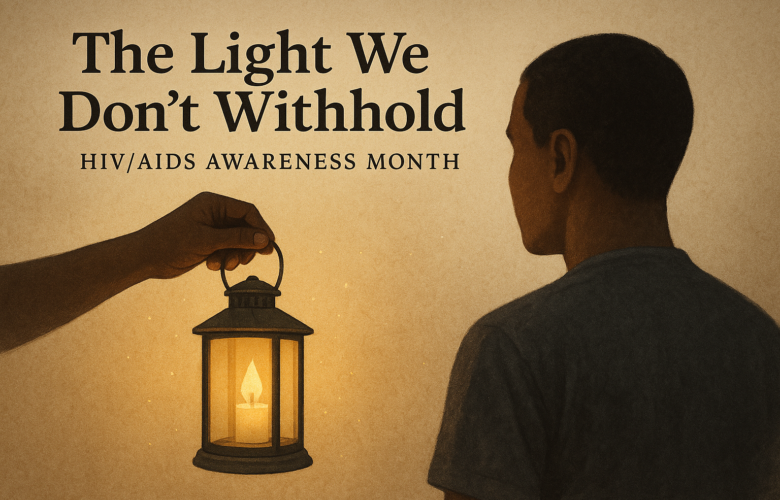
Every December, we enter a season of lights. Some are literal — porch bulbs, twinkle strings, candles in windows — and some are social: generosity, reconnection, softening toward each other after a long year.
And yet there is one kind of light our world still too often withholds.
The light of presence.
The light of understanding.
The light of uncomplicated human dignity.
December is widely observed as HIV/AIDS Awareness Month, anchored by World AIDS Day on December 1.12 Even though December 1, 2025 has passed, the month itself is still a meaningful window for reflection, education, and solidarity.
Here at The Church of Tinkerbell, we hold a simple ethic:
When pain is real, our kindness must be real too.
When shame is inherited, our compassion must be loud enough to break it.
When misinformation makes monsters of our neighbors, we choose curiosity and truth.
This is not a sermon about fear.
This is a reflection about care.
A brief grounding in reality (because wonder deserves facts)
HIV is not a moral verdict. It is a virus.
Globally, 40.8 million people were living with HIV in 2024. In that same year, about 1.3 million people acquired HIV and around 630,000 people died from AIDS-related illnesses.34 These numbers represent not only a continuing public-health challenge, but a continuing human challenge: whether societies will fund care, protect rights, and confront stigma rather than let fatigue, politics, or cruelty erode progress.
In the United States, CDC reporting notes that in 2023, over 39,000 people were diagnosed with HIV (in the U.S. and related territories), with persistent regional and demographic disparities.5
Statistics can feel abstract. But they are made of people:
someone’s partner,
someone’s sibling,
someone’s child,
someone’s future self.
The good news we should be shouting from rooftops
We often talk about HIV like it is frozen in the 1980s.
But modern treatment is powerful. Many people living with HIV who take antiretroviral therapy as prescribed can reach an undetectable viral load.
And here is one of the most important public-health messages of our time:
Undetectable = Untransmittable (U=U).
Meaning: a person living with HIV who is on treatment and maintains an undetectable viral load has zero risk of transmitting HIV to sexual partners.67
This is not just a medical fact.
It is a stigma-removing, life-giving, relationship-healing truth.
The tragedy is that many people still don’t know it — and many systems still fail to make treatment equitably accessible.
Why stigma is not just rude — it’s dangerous
Stigma doesn’t only hurt feelings.
It reduces testing.
It discourages honest conversations.
It interrupts care.
It isolates people who most need community.
When we shame people for a health condition, we don’t “protect morality.”
We protect ignorance.
And ignorance is costly.
A Tinkerbell parable about borrowed light
In some old imagined grove — one that may or may not exist depending on how much you’ve slept — a village kept its lanterns locked.
They told themselves it was for safety.
Light, they said, must be rationed.
Only the “wise” deserved it.
Only the “pure” could carry it.
So when a traveler arrived with their own dim, flickering lamp — the kind that needs tending — the village did not offer oil.
They offered judgment.
The traveler walked on in the cold.
The next winter, the village was darker than ever.
Not because light was scarce —
but because generosity was.
The moral of the story isn’t subtle:
A community that hoards compassion becomes spiritually impoverished, even if it thinks it is “correct.”
The 2025 invitation
The World AIDS Day 2025 theme highlights the need for resilience and renewed commitment: “Overcoming disruption, transforming the AIDS response.”89
In other words: progress is real, but not guaranteed. Hope isn’t passive. Hope is a commitment we renew when circumstances get messy.
What this month asks of us (in practical human terms)
You don’t have to be a clinician or an activist with a megaphone to matter. Here are grounded ways to participate in the light-sharing:
1. Learn and gently correct myths
A few reminders worth spreading:
- HIV is not spread through casual contact such as hugging, sharing food, or using the same bathroom.
- Treatment can allow people with HIV to live long, full lives.
- U=U is real.67
2. Normalize testing as routine care
Testing is not a confession.
It is maintenance — like checking your blood pressure or cholesterol.
3. Support access and equity
Consider donating to:
- local testing initiatives
- organizations serving LGBTQIA+ communities
- programs supporting communities disproportionately affected by HIV
- global groups working to maintain access to treatment and prevention
4. Choose language that treats people like people
Say:
- “people living with HIV”
not: - “HIV victims”
- “clean/dirty” when referring to status
The small choices add up.
A gentle invitation
If you are living with HIV and reading this:
You are not a cautionary tale.
You are not a symbol.
You are not a debate topic.
You are a whole person — deserving of pleasure, peace, safety, love, and the boring ordinary joys of daily life.
And if you love someone living with HIV:
Let your love be loud enough to drown out the cultural noise.
The closing ritual of this secular sanctuary
At The Church of Tinkerbell, our holiest acts are simple:
- We believe evidence is a form of care.
- We believe compassion is not optional.
- We believe the measure of a community is how it treats people when fear would be easier.
So in this month of awareness, and in the long winter beyond it, may we practice a little rebellion:
the rebellion of kindness without conditions.
Because light is not diminished by being shared.
It becomes visible.
Footnotes
- HIV.gov — World AIDS Day (December 1). https://www.hiv.gov/events/awareness-days/world-aids-day ↩
- CDC — World AIDS Day overview. https://www.cdc.gov/world-aids-day/index.html ↩
- UNAIDS — Global HIV & AIDS statistics fact sheet (2024 data). https://www.unaids.org/en/resources/fact-sheet ↩
- WHO — HIV data and statistics page reflecting 2024 global estimates. https://www.who.int/teams/global-hiv-hepatitis-and-stis-programmes/hiv/strategic-information/hiv-data-and-statistics ↩
- CDC — HIV Diagnoses, Deaths, and Prevalence: 2025 Update (2023 figures). https://www.cdc.gov/hiv-data/nhss/hiv-diagnoses-deaths-and-prevalence-2025.html ↩
- CDC — Undetectable = Untransmittable (U=U). https://www.cdc.gov/global-hiv-tb/php/our-approach/undetectable-untransmittable.html ↩ ↩2
- HIV.gov — Viral suppression and U=U. https://www.hiv.gov/hiv-basics/staying-in-hiv-care/hiv-treatment/viral-suppression ↩ ↩2
- WHO — World AIDS Day 2025 campaign page. https://www.who.int/campaigns/world-aids-day/2025 ↩
- UNAIDS — World AIDS Day themes page. https://www.unaids.org/en/World_AIDS_Day ↩

